Highlights


TuringDB 3.1 adds:
- Query parameters. You can send values with a query. You do not have to write them into the query text. See more
- The binary protocol for all clients. This protocol runs over HTTP/1.1. See more
- A TypeScript client on npm. This client uses WebAssembly to read the results. See more
- The
allReducefunction in Cypher. See more - Subqueries that can contain any query. See more
- A point type. You can use it to calculate distances on the Earth. See more
- Faster matches on key properties. When each row finds nodes by a key property, as in a
LOAD CSVthat adds edges, the query now uses a hash join. On a graph of 200,000 nodes, 1,000 edges take 7 ms instead of 5.7 s. See more
Most of your queries work without changes. If you use the Python SDK, you must change how you connect to the server. Refer to Upgrading from 3.0.
pip install -U turingdbuv add 'turingdb>=3.1'npm install turingdbReleased November 9, 2026 · Release on GitHub · All changes since 3.0.2
Query parameters
A $name parameter now stands for a value anywhere an expression goes, as well as for a label or an edge type. Values travel next to the query text, so they need no quoting or escaping:
client.query(
    "MATCH (n:Person) WHERE n.age >= $minAge RETURN n.name",
    {"minAge": 30},
)

# inside a change
rows = [
    {"name": "Brest", "pop": 139000},
    {"name": "Rennes", "pop": 220000},
]
client.query(
    "UNWIND $rows AS row "
    "CREATE (:City {name: row.name, pop: row.pop})",
    {"rows": rows},
)
await client.query(
"MATCH (n:Person) WHERE n.age >= $minAge RETURN n.name",
{ parameters: { minAge: 30 } },
);:param minAge => 30
MATCH (n:Person) WHERE n.age >= $minAge RETURN n.name- Parameters work in
WHERE,UNWIND, property maps,CREATE,MERGE,SET n += $propsand procedure arguments, and still stand for labels and edge types:MATCH (n:$label). - A parameter holds a string, a number, a boolean,
null, a list or a map. From Python it can also hold a time-zone-awaredatetime(a DateTime) or atimedelta(a Duration), and the shell’s:paramtakes any Cypher expression, such asdatetime('2024-01-01T00:00:00Z'). - Parameters travel faster than text: creating 10,000 edges from a list of node-ID pairs takes about 6 ms with the list as a parameter, against about 25 ms with the same list written into the query.
SKIP,LIMITand the vector of aVECTOR SEARCHstill take literals.
See Query parameters for the details, and IDs in parameters for the fastest lookups by node ID.
Example: flight connections
A travel application loads the flight schedule from an operations feed, then searches for one-stop connections between two airports. The whole schedule goes in as one parameter. The search takes the departure time, the minimum and maximum time to change planes, and the size of the party as parameters:
from datetime import datetime, timedelta, timezone

def at(hhmm):
    h, m = map(int, hhmm.split(":"))
    return datetime(2026, 11, 12, h, m, tzinfo=timezone.utc)

# Load a batch of scheduled flights from an operations feed
schedule = [
    # flight, from, to, departs, arrives (UTC), seats left
    ("TA100", "CDG", "AMS", "07:15", "08:35", 12),
    ("TA101", "AMS", "SFO", "09:40", "20:50", 4),
    ("TA200", "CDG", "LHR", "07:00", "08:15", 20),
    ("TA201", "LHR", "SFO", "08:45", "19:55", 9),
    ("TA300", "CDG", "FRA", "06:30", "07:45", 10),
    ("TA301", "FRA", "SFO", "10:15", "21:35", 7),
    ("TA400", "CDG", "MAD", "08:00", "10:05", 3),
    ("TA401", "MAD", "SFO", "12:10", "23:40", 1),
]
flights = [
    {"number": n, "src": s, "dst": d,
     "dep": at(dep), "arr": at(arr), "seats": seats}
    for n, s, d, dep, arr, seats in schedule
]
client.new_change()
client.query(
    """
    UNWIND $flights AS f
    MERGE (a:Airport {code: f.src})
    MERGE (b:Airport {code: f.dst})
    CREATE (a)-[:FLIGHT {number: f.number, seats: f.seats,
                         dep: f.dep, arr: f.arr}]->(b)
    """,
    {"flights": flights},
)
client.query("CHANGE SUBMIT")
client.checkout()

# One-stop connections with time to change planes,
# and enough seats on both legs for the whole party
client.query(
    """
    MATCH (o:Airport {code: $origin})-[f1:FLIGHT]->(hub)
          -[f2:FLIGHT]->(d:Airport {code: $destination})
    WHERE f1.dep >= $after
      AND f2.dep >= f1.arr + $minConnection
      AND f2.dep <= f1.arr + $maxConnection
      AND f1.seats >= $party AND f2.seats >= $party
    RETURN f1.number AS first, hub.code AS via,
           f2.number AS second, f2.arr AS arrives
    ORDER BY arrives
    """,
    {
        "origin": "CDG",
        "destination": "SFO",
        "after": at("06:00"),
        "minConnection": timedelta(minutes=45),
        "maxConnection": timedelta(hours=4),
        "party": 2,
    },
)
// The same search. JavaScript sends the time as an ISO 8601
// string and the connection times in minutes.
const [[first, via, second]] = await client.queryData(
"MATCH (o:Airport {code: $origin})-[f1:FLIGHT]->(hub)" +
"-[f2:FLIGHT]->(d:Airport {code: $destination}) " +
"WHERE f1.dep >= datetime($after) " +
"AND f2.dep >= f1.arr + duration({minutes: $minConn}) " +
"AND f2.dep <= f1.arr + duration({minutes: $maxConn}) " +
"AND f1.seats >= $party AND f2.seats >= $party " +
"RETURN f1.number, hub.code, f2.number " +
"ORDER BY f2.arr",
{
parameters: {
origin: "CDG",
destination: "SFO",
after: "2026-11-12T06:00:00Z",
minConn: 45,
maxConn: 240,
party: 2,
},
},
);The search returns two connections, via Amsterdam and via Frankfurt, in order of arrival. The connection in London is too short (30 minutes, less than the minimum of 45), and the flight from Madrid has only one seat left for a party of two. In Python, a datetime and a timedelta become DateTime and Duration values, so the query can add a connection time to an arrival time.
Example: GraphSAGE sampling for GNN training
A GNN training loop asks the server for the neighbourhood of each mini-batch with gnn.graphSAGE. The seed nodes of the batch are a parameter, so the query text is the same for every batch and only the values change. Before 3.1, each batch was a new query, with its node IDs written into the text.
import numpy as np

# Native node IDs of the training papers, read once
train = client.query(
    "MATCH (p:Paper) WHERE p.split = 'train' "
    "RETURN id(p) AS id"
)["id"].to_numpy()

hops = ", ".join(
    f"src_nodes{h}, tgt_nodes{h}" for h in range(3)
)
sample = (
    "CALL gnn.graphSAGE($seeds, $fanouts, $rngSeed) "
    f"YIELD {hops} RETURN {hops}"
)

rng = np.random.default_rng(0)
batches = [
    b.tolist()  # plain ints: numpy values are refused
    for b in np.array_split(rng.permutation(train), 100)
]

for seeds in batches:
    # One request per mini-batch, with the same query text
    df = client.query(sample, {
        "seeds": seeds,
        "fanouts": [15, 10, 5],  # from the seeds outwards
        "rngSeed": 7,            # optional, repeatable
    })
    # Hop h: sampled in-edges src_nodes{h} -> tgt_nodes{h}.
    # The hops have different lengths, padded with nulls.
    hop0 = df[["src_nodes0", "tgt_nodes0"]].dropna()
On a graph of 200,000 nodes and 400,000 edges, a batch of 1,000 seeds with fanouts of 15, 10 and 5 takes about 3 ms on the server. The same rngSeed gives the same sample for the same batch.
gnn.graphSAGE now also reads its arguments from each row, so one request can sample several mini-batches. The batch column tells which mini-batch each row comes from:
df = client.query(
    "UNWIND range(0, size($batches) - 1) AS i "
    "CALL gnn.graphSAGE($batches[i], $fanouts, $rngSeed) "
    f"YIELD {hops} RETURN i AS batch, {hops}",
    {
        "batches": batches[:4],
        "fanouts": [15, 10, 5],
        "rngSeed": 7,
    },
)
A seed that is not a node is refused with Invalid node ID: <id>. See Procedures for the arguments and the columns of gnn.graphSAGE.
Binary protocol by default
TuringDB’s binary protocol is now the default, and the only protocol the server speaks, on port 6666. It runs over HTTP/1.1: a query is one request to /query, and its result streams back as binary packets, one per HTTP chunk, on a connection that stays open for the next query:
POST /query?graph=people&commit=head&change=head HTTP/1.1
Content-Type: application/turing-proto
Authorization: Bearer <token>                (with -auth-on)

    the query text, then its parameters, in binary

HTTP/1.1 200 OK
Content-Type: application/turing-proto
Transfer-Encoding: chunked
Connection: Keep-Alive

    one binary packet per chunk:
    the column header, the column chunks, the end
Benchmark. The same queries on the same graph, from the Python SDK, with the JSON API of 3.0.2 and the binary protocol of 3.1:
| Query | 3.0.2, JSON | 3.1, binary | Faster |
|---|---|---|---|
| One node by ID | 0.64 ms | 0.12 ms | 5.3× |
| 1,000 nodes by ID, one query after the other | 551 ms | 126 ms | 4.4× |
| 200,000 rows: an integer and a string | 34 ms | 31 ms | 1.1× |
| 400,000 rows: two node IDs | 63 ms | 46 ms | 1.4× |
| 1,000,000 rows: an integer and a double | 168 ms | 104 ms | 1.6× |
- Typed columns end to end. A result streams as typed columns, in chunks of up to 65,536 rows, which each client turns straight into its own types: a pandas DataFrame in Python, typed arrays and
Columnobjects in JavaScript. - HTTP infrastructure works as is. Standard reverse proxies such as nginx forward the protocol with a plain
proxy_pass, browsers reach it withfetch, and authentication uses the standardAuthorization: Bearerheader, which a proxy can also add. - Every client speaks it. The Python SDK uses it by default,
TuringDB(host="localhost", port=6666), and so do the new TypeScript client, the shell’sconnect <addr> <port>and the visualizer.
Use one of the clients rather than writing requests by hand. See Connecting clients.
A TypeScript client on npm, built on WebAssembly
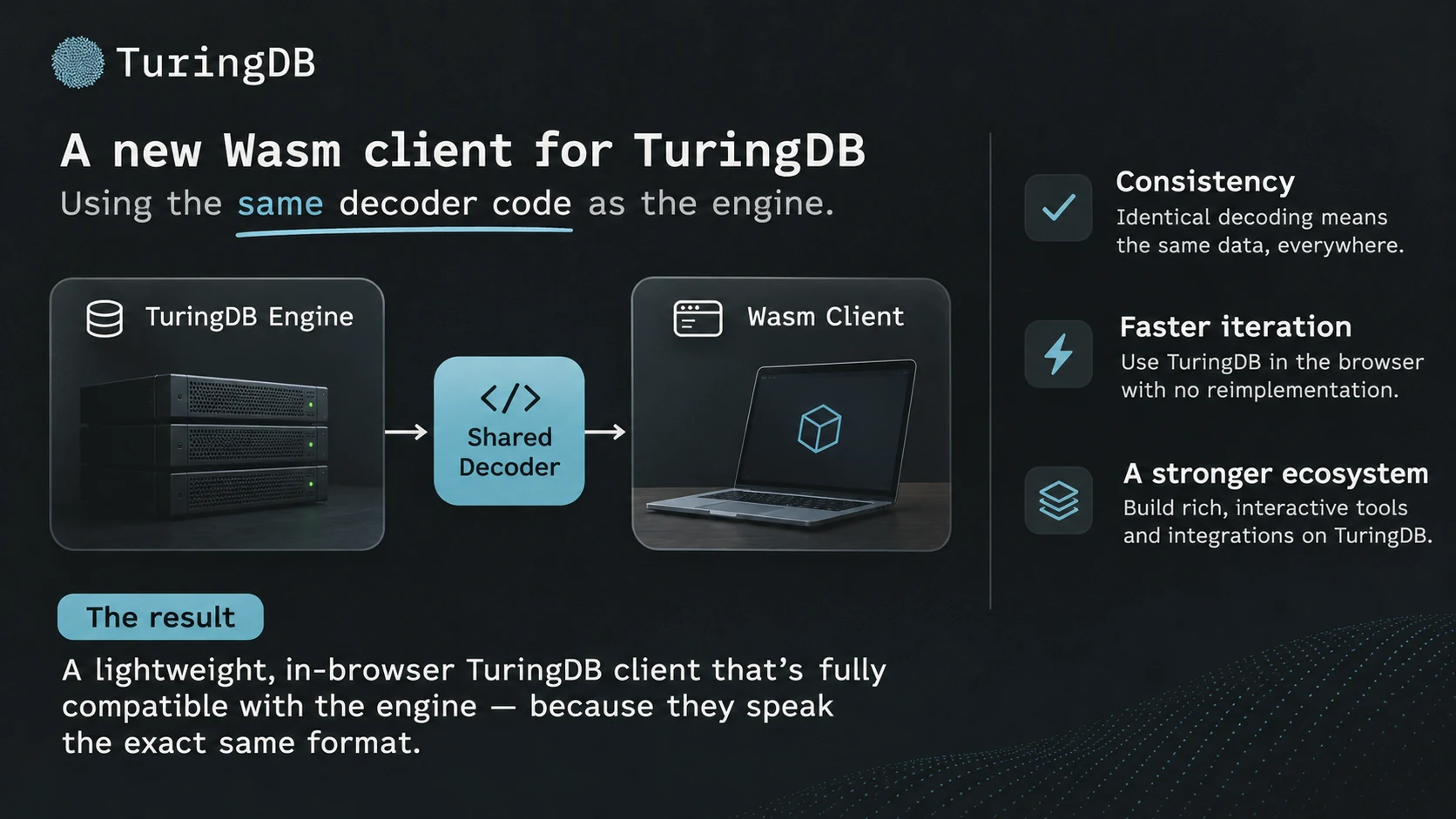
The turingdb npm package queries TuringDB from TypeScript and JavaScript. It decodes the streamed columns with a WebAssembly build of the engine’s own decoder, so the browser, Node.js and the server run the same decoding code. It runs in Node.js 18 or later and in the browser, has no dependencies, and ships with TypeScript declarations.
import { TuringClient, TuringQueryError } from "turingdb";

const client = new TuringClient({
    url: "http://localhost:6686/query",
    graph: "people",
});

try {
    const [[names, ages]] = await client.queryData(
        "MATCH (p:Person) WHERE p.age >= $age " +
        "RETURN p.name, p.age ORDER BY p.name",
        { parameters: { age: 30 } },
    );
    console.log(names, ages);   // [ 'Marie' ] [ 33 ]
} catch (e) {
    if (e instanceof TuringQueryError) {
        console.error(e.status, e.message);
    }
}- Typed columns.
query()returnsColumnobjects: 64-bit integers and node IDs asbigint, numeric columns as typed arrays with no per-row work, embeddings asFloat32Arrayand points asPointobjects.queryData()returns plain arrays. - The whole workflow. Parameters, changes (
CHANGE NEW,setChange(),CHANGE SUBMIT), past commits through thecommitoption, cancellation with anAbortSignal, and-auth-ontokens. - Node.js and the browser. Node.js refuses port 6666, so start the server on another one, such as
turingdb -p 6686. A web page reaches the server through a proxy on its own origin, and Vite, webpack 5 and other bundlers ship the.wasmdecoder with the build.
Read Get started for a walkthrough, including a Vite and nginx setup for web applications, and the Reference for every option and type.
allReduce
allReduce(acc = init, x IN list | step, predicate) folds a list like reduce, and is true when the predicate holds for the accumulator after every step. It stops at the first step that fails. Over the nodes or edges of a path, it tests a condition at each hop:
MATCH p = (a:Person {name: 'Alice'})-[:KNOWS]->+(b)
WHERE allReduce(
  total = 0, n IN nodes(p) | total + n.age,
  total <= 100
)
RETURN b.name, length(p) AS hops
The ages along Alice → Bob → Carol add up to 93, so the paths to Bob and Carol are kept, while adding Dave makes 134. A map accumulator carries more than one value from step to step, for example to keep the paths along which the since years of the edges increase:
MATCH p = (a:Person {name: 'Alice'})-[:KNOWS]->+(b)
WHERE allReduce(
  acc = {}, r IN relationships(p) |
    {prev: acc.cur, cur: r.since},
  acc.prev IS NULL OR acc.prev < acc.cur
)
RETURN b.name, length(p) AS hops
The initial value is never tested, an empty list gives true, and a null list gives null. Paths are values too: collect(p) gathers them, lists and maps hold them, and a pattern comprehension can name its path, as in [p = (a)-[:KNOWS]->+() | length(p)]. See Filtering paths with allReduce.
COLLECT and other subqueries
Every subquery now holds any query. UNION, NEXT chains and WHEN conditionals work inside COLLECT, EXISTS, COUNT and CALL bodies, and a WHEN branch can hold a UNION:
MATCH (p:Person {name: 'Alice'})
RETURN COLLECT {
  MATCH (p)-[:KNOWS]->(f)
  RETURN f AS friend
  NEXT
  MATCH (friend)-[:KNOWS]->(fof)
  RETURN fof {.name, .age}
} AS twoHopsAway

MATCH (p:Person)
WHERE EXISTS {
  WHEN p.age > 30 THEN MATCH (p)-[:KNOWS]->(f) RETURN f
}
RETURN p.name

MATCH (p:Person)
RETURN p.name, COUNT {
  WHEN p.city = 'London'
    THEN MATCH (p)-[:KNOWS]->(f) RETURN f AS x
  ELSE MATCH (p)-[:LIKES]->(x) RETURN x
} AS links
COLLECT { }andcollect()gather maps and paths, so a subquery can collect several values per match:COLLECT { MATCH (p)-[:KNOWS]->(f) RETURN f {.name, .age} }.- The branches of a
UNIONor aWHENcan return different types in one column. exists()takes a pattern as a function, as in Neo4j 5:RETURN p.name, exists((p)-[:LIKES]->()) AS likes.
See Subqueries and NEXT and WHEN.
Example: drone fleet status
A fleet dashboard shows each drone docked at a base: its battery, whether it can fly, its last two flights and its maintenance tasks. One query builds a document for each drone. The tasks come from two sources, open faults and parts due for service, joined by a UNION inside COLLECT. The graph has this structure:
The query:
MATCH (d:Drone)-[:DOCKED_AT]->(:Base {name: $base})
RETURN d {
  .id, .battery,
  ready: d.battery >= $minBattery AND NOT EXISTS {
    MATCH (d)-[:HAS]->(:Part)
          <-[:AFFECTS]-(:Fault {open: true})
  },
  lastFlights: COLLECT {
    MATCH (d)-[f:FLEW]->(m:Mission)
    RETURN m {.id, km: f.km} ORDER BY f.at DESC LIMIT 2
  },
  tasks: COLLECT {
    MATCH (d)-[:HAS]->(p:Part)
          <-[:AFFECTS]-(x:Fault {open: true})
    RETURN 'repair ' + p.name + ' (' + x.code + ')' AS task
    UNION
    MATCH (d)-[:HAS]->(p:Part)
    WHERE p.hours >= p.serviceHours
    RETURN 'service ' + p.name AS task
  }
} AS drone
ORDER BY drone.id
With $base set to 'Lyon-Nord' and $minBattery to 30, it returns one document for each drone:
{"id": "D-101", "battery": 82, "ready": true,
  "lastFlights": [{"id": "M-884", "km": 8.1},
                  {"id": "M-881", "km": 12.4}],
  "tasks": ["service camera"]}
{"id": "D-102", "battery": 24, "ready": false,
  "lastFlights": [{"id": "M-882", "km": 21.7}],
  "tasks": []}
{"id": "D-103", "battery": 67, "ready": false,
  "lastFlights": [{"id": "M-861", "km": 5.2}],
  "tasks": ["repair rotor 2 (E-17)", "service gimbal"]}
D-102 cannot fly because its battery is below 30%, and D-103 because of the open fault E-17 on a rotor. A drone with no flight or no task gets an empty list, and its row is kept.
Points and haversine distance
Points are a new property type, 2D or 3D, on a plane (cartesian) or on the Earth (WGS-84). point.distance gives the great-circle distance in metres between two WGS-84 points, by the haversine formula on a sphere of the mean Earth radius:
CREATE
  (:City {name: 'Paris',
    at: point({latitude: 48.8566, longitude: 2.3522})}),
  (:City {name: 'London',
    at: point({latitude: 51.5074, longitude: -0.1278})})

MATCH (a:City {name: 'London'}), (b:City {name: 'Paris'})
RETURN round(point.distance(a.at, b.at) / 1000) AS km

MATCH (c:City)
WHERE point.withinBBox(
  c.at,
  point({latitude: 48, longitude: 1}),
  point({latitude: 50, longitude: 3})
)
RETURN c.name
The second query returns 344, and the third returns Paris.
- Building and reading.
point({x, y}),point({x, y, z}),point({longitude, latitude})andpoint({longitude, latitude, height}), read back throughp.x,p.latitude,p.crs,p.sridand the other components. - Distances. Straight-line between cartesian points. Great-circle on the Earth’s mean radius, 6,371,008.8 m, between WGS-84 points, and combined with the height difference in 3D. Neo4j uses a radius of 6,378,140 m, so its distances are about 0.11% longer.
- Bounding boxes.
point.withinBBox(p, lowerLeft, upperRight), with boxes that can cross the 180th meridian. - Sorting and aggregating. Points compare, sort, group and deduplicate, and
min,maxandavg, the centroid, work over them. - Importing.
LOAD JSONL ... WITH POINTS [...]reads JSON objects as points, andLOAD PARQUETreads the WKB point columns of GeoParquet files. - Clients. Points come back as
turingdb.Pointin Python and asPointobjects in TypeScript.
See Points.
Also in 3.1
Map projection and map access
MATCH (n:Person)-[:WORKS_AT]->(c:Company)
RETURN c.name,
  collect(n {.name, .age, senior: n.age > 30}) AS staff

WITH {a: {b: 2}, label: 'x'} AS m
RETURN m.a.b, m['label']
n {.*} takes every property, and a map can hold nodes and datetimes and read through them: m.p.name, m.d.year. See Map projection.
Setting properties from a map
MATCH (n:Person {name: 'Alice'})
SET n += {city: 'Berlin', score: 1.5}

MATCH (c:Company {name: 'Acme'})
SET c = {name: 'Acme Corp', size: 10}
SET n += map adds and updates properties, SET n = map replaces them all, and a key set to null removes its property. See Setting properties from a map.
New functions and operators
| Added | Example |
|---|---|
IS label tests | WHERE n IS Person|Company |
elementId(x) | The same integer as id(x) |
isEmpty(x) | isEmpty([]), isEmpty('') and isEmpty({}) are true |
coll.indexOf(list, value) | coll.indexOf(['a', 'b'], 'b') is 1 |
split on several delimiters | split('a,b;c', [',', ';']) is ['a', 'b', 'c'] |
datetime of a map | datetime({year: 2024, month: 3, day: 15, hour: 10}) |
sum and avg of durations | sum(d) over Duration values |
A new parser
A hand-written recursive descent parser replaces the generated one. It is much faster, and reads queries the way Neo4j does:
- Much faster. In our measurements, it parses queries about twice as fast as the parser of 3.0: a 12-line query in 23 µs instead of 54 µs, and a 130 KB query in 6.6 ms instead of 13 ms.
/* */block comments, and keywords as names:RETURN n.name AS count, n.age AS order.STARTS WITH,ENDS WITHandCONTAINSbind more loosely than+, so'a' + 'bc' ENDS WITH 'bc'istrue.- Dotted chains read through nested values:
m.a.b,m['key'],ms[1].a.
Faster key-property matches
A query often finds nodes by a key property for each row, for example in the edge pass of a LOAD CSV:
LOAD CSV 'knows.csv' WITH HEADERS AS row
MATCH (a:Person {pid: toInteger(row.src)}),
  (b:Person {pid: toInteger(row.dst)})
CREATE (a)-[:KNOWS]->(b)
In 3.0, each row scanned all the nodes with the label. In 3.1, the query scans the label one time and joins the rows to it with a hash join. Measured on the same graph of 200,000 nodes and 400,000 edges:
| 1,000 rows | 3.0.2 | 3.1 |
|---|---|---|
LOAD CSV that adds edges by key, as above | 5.7 s | 7 ms |
UNWIND of key pairs, with a match by key for each node of the pair | 7.6 s | 9 ms |
UNWIND of keys, with one match by key | 245 ms | 4 ms |
Key pairs passed as a parameter (UNWIND $pairs AS p) also use a hash join. One key for each row from a parameter (UNWIND $keys AS x MATCH (n:Person {pid: x})) does not use a hash join yet. For this case, get the node IDs of the keys, and use UNWIND $ids AS x MATCH (n) WHERE n = x.
More of what you write just works
- Writes store values read from maps and lists directly:
CREATE (:City {name: row.name, pop: row.pop})needs notoString()ortoInteger(). A new property takes the type of its values. - Paths are values: lists and maps hold them, and
CASEandcoalescereturn them, as incollect(p),{route: p}andcoalesce(p, q). ORDER BYafterDISTINCTor beside an aggregate sorts by a key or a property of a returned item:RETURN DISTINCT {age: n.age} AS m ORDER BY m.age.WHERE n IN [0, 1, 2]looks the nodes up by ID directly, likeUNWIND [0, 1, 2] AS x MATCH (n) WHERE n = x.range()takes bounds read from maps and lists, andsum()of integers read from maps stays an Integer.- A runtime type error names the type the row holds:
toUpper() reads a string, not 'Integer'. gnn.graphSAGEreads its arguments from each row, and rejects a seed that names no node.- The planner starts a pattern from the node expected to produce the fewest rows, with estimates built from the number of edges of each type, and sizes a hash join by its smaller side.
Python SDK
TuringDB(host="localhost", port=6666)connects over the binary protocol, as soon as it is created.typeis"native", the default, or"embedded".- A
DateTimeor aDurationinside a list or a map comes back as a time-zone-awaredatetime.datetimeor adatetime.timedelta, rather than a string. list_available_graphs()works on every backend, the embedded one included.try_reach(timeout)andwarmup(timeout)give up aftertimeoutseconds.- The package no longer depends on
httpxandorjson.
See the Python SDK reference.
Upgrading from 3.0
Upgrade the server and the clients together
A 3.1 client speaks the protocol of a 3.1 server, so upgrade turingdb on PyPI, turingdb on npm and the server at the same time, then restart the server:
pip install -U turingdb
turingdb stop && turingdb -demon
A client and a server of different versions fail with a protocol error, see Troubleshooting.
Connect with a host and a port
Pass the host and the port separately:
from turingdb import TuringDB

# or simply TuringDB()
client = TuringDB(host="localhost", port=6666)
A URL in host is refused with host must be a host name or IP address, not a URL. The client now connects as soon as it is created, so a server that is not running is reported right away.
Read paths as lists of IDs
RETURN p returns a path as a list of IDs, node and edge alternating: [0, 0, 1] is node 0, edge 0 and node 1. Code that read the type and id keys of each step should read the list instead.
Check the results that changed
A few results now follow Neo4j:
| Expression | 3.0 | 3.1 |
|---|---|---|
[1, 2] + null | [1, 2, null] | null |
{a: null} = {a: 1} | false | null |
'a' + 'bc' ENDS WITH 'bc' | 'atrue' | true |
duration({hours: null}) | null | an error naming the unit |
sum(row.v) over integers read from maps | a Double | an Integer |
Pass values as parameters
Optional, but recommended: replace the values your application writes into query text, and the code that escapes them, with parameters. They are safer and faster.
Removed
- The JSON API. The server answers the binary protocol only, so scripts that sent JSON queries to it, with
curlfor example, need one of the clients. - In the Python SDK:
type="json", a URL inhost, theHTTPClientclass and theTURINGDB_TYPEenvironment variable. - On the server: the
USE_TURING_PROTOenvironment variable, since the binary protocol is always on, and theREQUEST_TOO_BIGerror code. A request over 1 MiB is now refused with a protocol error that names the limit.
Known limitations
These are not available yet, and are on the roadmap:
- Parameters in
SKIPandLIMIT, and as the vector of aVECTOR SEARCH. - Regular expressions (
=~) and--comments. rand(),date(),timestamp(),atan2(),isNaN()andround(x, digits).SET n:Label,CALL { } IN TRANSACTIONSandOPTIONAL CALLon a procedure.
Tell us which ones matter to you on Discord or by email at team@turingdb.ai. For the full list of changes, see the v3.1 release on GitHub.